Nigeria's Premier Art Auction House

Nigeria’s Booming Art Market

(CNN)Amid strong demand and skyrocketing prices, contemporary African art is increasingly attracting the attention of investors worldwide.

While that might irk the purest at heart among some art collectors, it is a testament to the growing interest that African artists have spurred on the international markets.
British auction house Bonhams has seen average lot prices increase 5-fold — to about $50,000 — since it started specializing in contemporary African art in 2007.
ArtHouse Contemporary Limited, an auction house based in Lagos, Nigeria, notes that pieces bought at their very first auction, back in 2008, have increased up to 10-fold in value today.
The trend falls within a general rise in value for African art as a whole — Sotheby’s, whose auctions currently combine African and Oceanic art, took in an “outstanding” $84 million in 2014, compared to just $4 million a decade ago. They are now considering specialized sales for African art alone.

From nothing to millions

You’d be hard pressed to find a man who has witnessed the rise in recognition and value of African art better than Prince Yemisi Shyllon, who is reported to be Nigeria’s largest private art collector.
“When I started collecting art as an undergraduate at university in the mid 1970s, it had virtually no value,” he told CNN.
“You could buy a piece of good art for 20,000 Naira [about $100 at current conversion rates]. Today it would sell for millions.”
He now has about 7,000 pieces, which he displays in his house in Lagos.
“I’ve studied the movement of the prices of artwork sold in auctions in Nigeria since 1999,” he said. “And I can tell you how much the artworks have grown over time, of different artists — if we draw a correlation analysis we come up with a positive graph about the growth, and therefore it can form a solid basis for investment.”

Africans buy African art

At least half of the contemporary African art sales registered at auctions worldwide are believed to come from buyers within the continent, chiefly Nigeria and South Africa.
“Nigeria has the largest population, it’s the largest economy and oil producer today,” Kavita Chellaram, chief executive at ArtHouse Contemporary Limited, told CNN.
“Half the billionaires of Africa live between Nigeria and South Africa, so I think the prominence of the art here is quite relevant to the financial market.”
Experts also cite the strong growth of African economies and the rising wealth of the middle class as leading factors in the surge of interest around contemporary African art
Giles Peppiatt, director of contemporary African Art auctions at Bonhams, says his numbers confirm the investment appeal of African art, even though the average prices are still reasonable: “I think that in the African sales, the majority of the works sell between $10,000 and $60,000.
“It’s still relatively modest, and that’s healthy, because it means it’s a market where new entrants can come in. I think it’s a 10th of the entry price of some other markets, but that’s to be expected because it’s a very new one.”

Global interest

The rise in fame of contemporary African artists on the international stage is also starting to fuel solo exhibitions abroad, such as the one offered by the Brooklyn Museum in 2013 on Ghanaian sculptor El Anatsui, whose “New World Map” went for a record £541,250 at auction in 2012.
Yet, it’s not easy to decode why the trend has exploded only just recently.
According to Peppiatt, there are two reasons: “Until about 15 years ago there was no email, there was virtually no internet and you can’t do these sales without modern communication.
“I also think it has to do with the general globalization of the art world. People are now much more used to seeing other cultures’ art at auction.”
150916113301-africanart-04-exlarge-169
Ghanaian artist El Anatsui.

A bright future

At the moment, large international players such as Bonhams still hold their events in Europe or the U.S. “I think it’ll be a while before we start auctioning works in situ in Africa,” said Peppiatt.
“We have offices in Lagos and Johannesburg, I think it will remain that way for a bit. There’s also the advantage that there’s a whole structure of art dealing and art selling is here in London — the restorers, the conservators, the transport, the shippers, the packers. Everything is here and it’s very easy for people to buy and sell in London.”
Yet. ArtHouse Contemporary, who hold their auctions in Lagos, are noticing encouraging local trends: “There’s much more awareness,” said Chellaram. “People all over Nigeria and Africa today are looking towards art, and in fact Kenya has opened an auction house, Uganda’s having an auction this year, so there is a bit of a domino effect in Africa,” she continued. “Auctions can provide a platform to showcase African art to the world.”
And according to Prince Yemisi Shyllon, who’s planning to open a private art museum in Lagos, the fundamental role of art should not be overshadowed by the investment appeal: “I don’t believe collections should just be about collecting and enjoying art. I think it should go beyond just collecting — it should go into the element of propagating the culture or the heritage of the people and way of life of the people.
“Not only that, it should finally go to the extent of creating a legacy.”


Expanding future with four Artists at Arthouse

Dipo Doherty, Olumide Onadipe, Tyna Adebowale and Jelili Atiku are the recipients of Arthouse Foundation’s 2016 Residency. To expand the scope of their skills, the artists will start arriving for a two-month residency programme from tomorrow.

Arthouse Foundation, which was announced two years ago, appears to be blazing another trail in re-energising the Nigerian, perhaps, by extension, African visual arts space. It is a branch of West Africa’s premiere art auction house, Arthouse Contemporary Limited.

A not-for-profit initiative, the Foundation comes at a period when the Nigerian art is finding new levels on the international art space.

The residency, according to curator at Arthouse Foundation, Joseph Gergel, is sectionalised into two phases: Doherty and Onadipe for April 18 to June 22, while Adebowale and Atiku will enjoy theirs from September 12 to December 16.

Quietly, the Foundation has sponsored Nigerian artists to residency outside Nigeria. Tayo Olayode and Uche Joel Chima are beneficiaries of such gesture, which had the artists on residency to Vermont, U.S. Currently, the first Arthouse Resident artist, Victor Ekpuk, is showing his solo titled, Coming Home, an exhibition from the residency programme. Ekpuk had his residency in Lagos last year at a temporary facility of Arthouse near the promoters’ office.

“With a newly renovated building in the heart of Ikoyi, it offers live/work residencies for two artists throughout the year in three-month sessions,” Gergel disclosed. “The Foundation aims to encourage creative development of contemporary art in Nigeria by providing a platform for artists to expand their practice and experiment with new forms and ideas.”

Details of the residency include, offer of a live/work studio, art materials and logistical support for the creation of a new artistic project, for each artist, during their residency. Other benefits include an intensive public initiative throughout each residency, including an artist’s talk, workshop, open studios and roundtable discussion.

For each of the artists, the big one is an opportunity to share the proceeds of the residency with the public in art exhibition to be organised by the Foundation. The exhibition is expected to hold at the end of the year.

Ahead of the residency proper, the first public event is Meet the Artists, holding on Saturday, April 23, at the Foundation house, off Awolowo Road, Ikoyi, Lagos. Described as informal gathering, Meet the Artists, “will allow the public to learn about the residents’ artistic practice and plans for their project during the residency.”

Excerpts from Doherty’s biography shows that he was born in 1991. He is a painter whose work explores the language of spatial geometry, with a focus on the depiction of the self and the human form.

Binding together a dynamic set of styles and motifs, Doherty creates abstracted figures that give expression to emotional, cultural and scientific energies. A graduate of the University of Virginia, Doherty has held recent solo exhibitions at Red Door Gallery and Nike Art Gallery in Lagos.

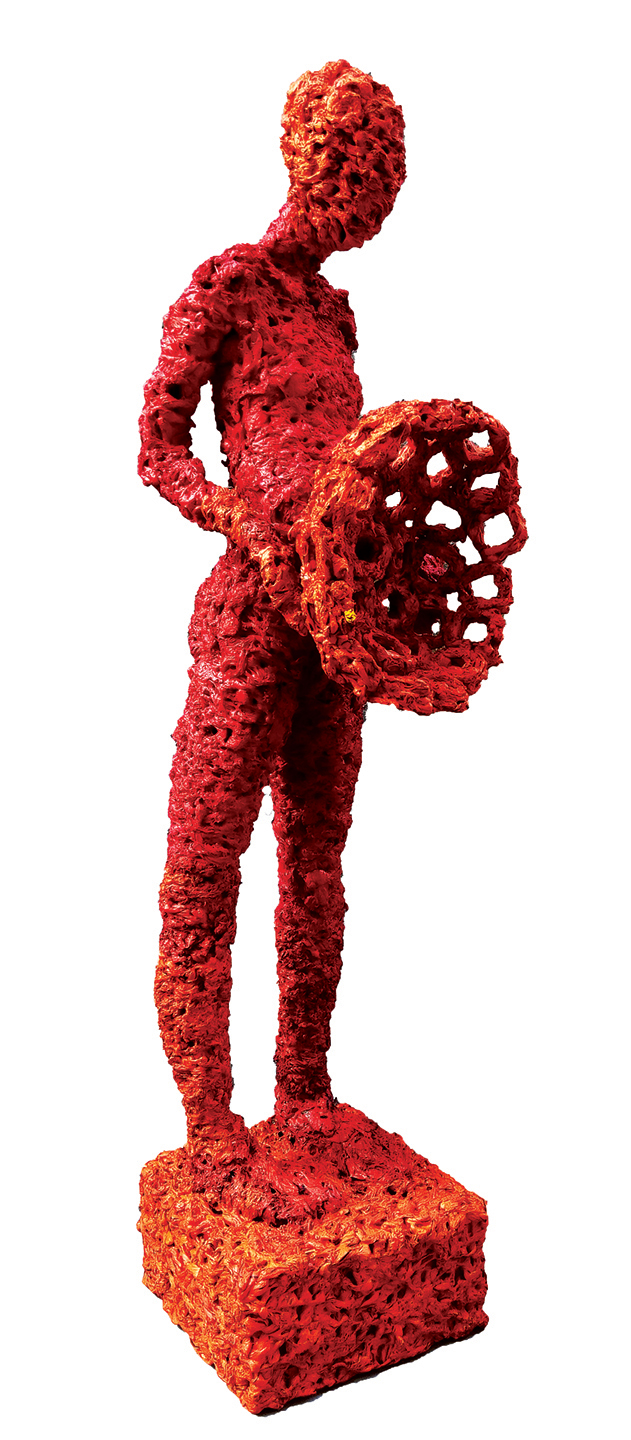
Onadipe was born in 1982. He is a sculptor, who engages experimental processes that involve the manipulation of tactile materials. His recent work incorporates materials such as plastic bags, metal, wood, jute bags and glass, using a process of twisting and melting to create amorphous shapes that play with sculptural balance.

A graduate of Fine Art from the University of Nigeria, Nsukka, Onadipe has held two solo exhibitions at Pan Atlantic University, Lagos.

Adebowale was also born in 1982. He is a mixed media artist, who utilises texts, pigments and found materials to explore issues of gender, sexuality and identity. Her work comments on topics spanning Nigeria’s dysfunctional political landscape and the impact of social media in contemporary society.

A graduate of painting from Auchi Polytechnic, Adebowale has completed residencies at the Instituto de Arte E Cultura Yuroba in Brazil and Asiko Art School in Ghana.

Born in 1968, Atiku is a performance and multi-media artist, who examines political concerns for human rights and justice. Through drawing, installation, sculpture, photography, video and performance art, he comments on the psychological and emotional effects of traumatic events including violence, war, poverty, corruption and climate change. A graduate of University of Lagos and Ahmadu Bello University, Zaria, Atiku was the recipient of the prestigious Prince Claus Award in 2015.

Nigerian art collectors rode economic boom

For much of Nigeria’s history, private collectors of art have been marginal and unacknowledged players on the scene. It was not until the rapid growth of private galleries, which began tentatively in the 1990s and accelerated in the 2000s, that a band of collectors emerged and attracted attention.

“These are the people who, come rain or shine, would always make sure to attend [exhibitions],” says Bolanle Austen-Peters, founder and chief executive of Terra Kulture, one of Lagos’s most prominent private arts venues, housing a gallery, performance space and bookstore. “We started to call them the collectors.”

Ask artists and gallery owners about Nigerian collectors and the same names are mentioned: Yemisi Shyllon, Adedotun Sulaiman, Sammy Olagbaju, Newton Jibunoh, Rasheed Gbadamosi, Femi Akinsanya, Gbenga Oyebode, Kavita Chellaram, Abdulaziz Udeh and Joe and Sandra Obiago, among others.

Many have been collecting for decades. Newton Jibunoh founded the Didi Museum, which describes itself as Nigeria’s first private museum, in 1983, while Adedotun Sulaiman, a former country managing director of Accenture’s Nigeria practice, collected his first artwork in 1979. His collection, he says, “is now close to 400 pieces”.

Yemisi Shyllon is believed to be Nigeria’s largest private collector. His more-than 6,000 pieces, which he started collecting as an engineering undergraduate at the University of Ibadan in the 1970s, are displayed on the grounds of his home on the Lagos mainland.

Other collectors have benefited from Nigeria’s recent growth. The country’s economy was one of the fastest growing in the decade to 2014. That year, it overtook South Africa as Africa’s largest.

The fortunes of the super-rich have been built on the unprecedented boom in oil and gas, banking, construction, telecommunications and consumer retail. Nigeria was one of 15 countries worldwide in which, in 2014, the number of “ultra-high net worth individuals” — those with investable assets of at least $30m — grew by at least 5 per cent, according to the Knight Frank Wealth Report 2015.

Mrs Chellaram, an ethnic Indian whose family has lived and done business in Nigeria for decades, established Arthouse Contemporary, Nigeria’s first auction house, in 2007 — the same year Bisi Silva, the curator, founded the Lagos Center for Contemporary Art (CCA).

A handful of institutional collectors are also prominent. The Pan-Atlantic University in Lagos houses an extensive collection, as do the headquarters of Guaranty Trust Bank and Access Bank. Terra Kulture started its own auction in 2008 when Guaranty Trust asked it to help sell works taken from defaulting debtors and in 2011, the bank created a fund to support Tate Modern’s ambitions to expand its African collection.
Emerging Voices
Venezuelan filmmaker Jackson Gutierrez
Venezuela’s Jackson Gutierrez makes films that are gangland hits

The director has risen from barbering in a slum to capturing Caracas’s violence on screen

Recent years have seen an intensifying of the sense of community among Nigeria’s collectors. The Obiagos initiated the Collectors’ Series Forum in 2009, not only to take art out of the gallery and into public spaces such as hotels, but also to serve as a networking platform for artists and collectors.

Then there are the auctions. Since 2008, Terra Kulture and Arthouse Contemporary have organised separate auctions in Lagos. Terra Kulture’s — in partnership with Mydrim Gallery — is annual, while Arthouse’s is held twice a year. These sales have collectively raised more than $1m in recent years.

Nigerian art is also increasingly finding an international market. In 2009, Bonhams, the British auction house, started Africa Now, its Africa-focused auction.

Africa’s two biggest economies play commensurate roles: South African and Nigerian buyers dominate a market in which the most prominent artists are also South African and Nigerian.

“Most [Nigerian collectors] collect only Nigerian art, as it’s at par with any other, and resonates more with our surroundings,” says Terra Kulture’s Ms Austen-Peters. “Ninety per cent of my collection is Nigerian,” says Mr Sulaiman. “Ninety-nine per cent is African.”

The most expensive work by a Nigerian artist sold at auction is a set of sculptures by the late Ben Enwonwu, which fetched £361,250 in May 2013 in London. His 1976 oil painting, Princes of Mali, made £92,500 at Africa Now in 2014. (One of Mr Enwonwu’s most famous works is his bronze sculpture of Queen Elizabeth II, for which she sat at Buckingham Palace in London in 1957.)

Mr Sulaiman says the costliest sculpture and painting he has ever bought are both Enwonwus: he bought the sculpture in 2015 for N5m ($25,100), while the painting cost N3m 10 years ago.
Related article
Kapwani Kiwanga performing ‘Afrogalactica: A Brief History of the Future’ in 2012
African artists on the way up

From the Venice Biennale to New York’s Armory Show, the art world’s love affair with Africa is hotting up

Auctions can however be problematic, cautions Ms Austen-Peters. “Because of the auctions, a lot of younger artists now think art has to be expensive. Art auctions are artificial spaces, they don’t give the right indication of the art market. Exhibitions are better at giving the true value [of art].”

Terra Kulture, founded in 2004, now holdss over 20 exhibitions every year. A recent opening is Rele Gallery, which has held 9 exhibitions since it opened a year ago.

“From experience, it’s the same crowd you’ll see attending exhibitions and collecting work,” says Rele founder Adenrele Sonariwo. “That’s why we started Rele — we wanted to see a new crowd appreciating and collecting art.” The first step, she says, is getting new faces into the galleries. “They might not have the income now, but once their pockets deepen they’ll remember us and come back.”

Azu Nwagbogu, director of the African Artists’ Foundation, which he founded in 2007, and which organises the annual National Art Competition, shares similar enthusiasm.

“One of the things that excites me is that a lot of young people are starting to participate,” he says, adding that the younger collectors are pushing the boundaries. “They’re collecting more risky, more experimental art.” (Mr Nwagbogu’s brother, Chike, runs the Nimbus Gallery, which organised what is acknowledged as Nigeria’s first arts auction, in 1999, just as the country emerged from its longest-ever spell of military rule.)

‘At the moment, those driving the African-American art world are the hip-hop stars’
Victor Ehikhamenor, poet and artist

But these are also difficult times for Nigeria, as the price of crude oil, its primary source of government revenues and foreign exchange, has fallen by 70 per cent since mid-2014. Businesses lament that ensuing import and currency restrictions are hurting them.

To shore up flagging revenues, the government has considered imposing a tax on luxury goods.

Nevertheless, Adenrele Sonariwo, preparing to celebrate the first anniversary of her gallery, is optimistic. “Rele started at a time when the economy was at a low point; there was political uncertainty and people weren’t spending money, yet we managed to have an OK year,” she says. “I think things can only get better this year.”

There is still plenty of untapped potential for swelling the ranks of young art enthusiasts and collectors, says poet and artist Victor Ehikhamenor, whose work has also featured in Africa Now at Bonhams.

His current ambition is, by pursuing collaborations with the country’s biggest hip-hop stars, to get them interested in art. (His book covers for well-known Nigerian writers have succeeded in turning a number of them into collectors of his work.)

“At the moment, those driving the African-American art world are the hip-hop stars,” Mr Ehikhamenor says. “Imagine if Nigeria’s young musicians, given to buying expensive cars with no second-hand value, started collecting Nigerian art — it’d change the game overnight.”

How Grillo’s Igi Araba changed the face of art in Lagos

Ordinally, the KIA Motors showroom located at Adelu Odeku street, Victoria Island is one of the places customers go to purchase their various range of cars, but the place received unusual visitors last month when people from all walks of life, especially art lovers trooped to the place not to buy cars, but to be part of the unique solo exhibition organised by Arthouse Space for one of Africa’s living modernist masters, Prof Yusuf Grillo titled Igi Araba .

The solo exhibition which could be described as the mother of all exhibitions, is coming up 40 years after his last outing, featured body of works that make his legendary night blue strokes glow with some of the never-before-seen paintings. Also among the new works were stained glass pieces, rendered in a medium of which Grillo, for several decades, asserts his great signature.

Given the artist’s background as teacher of masters as well as dream collection of many art lovers, any art event that focuses Grillo means so much to quite diverse shades of art enthusiasts.

So the opening was a carnival like as it was graced by prominent Nigerians, captains of industry, diplomats, expatriates, art collectors, promoters and lovers especially the members of the Zaria rebels.

It was declared open by the Deputy Governor of Lagos State, Ranti Adebule who represented Governor Ambode of Lagos State. Others include former governor of Akwa Ibom State, Obong Victor Attah, Prof. Bruce Onobrakpeya, Demas Nwoko, Jimoh Okolo, Prof JP Clark, Prof Ebun Clark, Jerry Buhari , Oleseinde Odimayo, Kolade Oshinowo and a host of others.

A look at some of the works shows his masterly rendition of his strokes as in the piece, Kabiyesi and Olori (oil on canvas, 2010-2012). Grillo also celebrates his resilient Yoruba cultural value, as shown in the painting, which is about royal couple that captures the flowing elegance in the native iro / buba for the queen and buba/agbada for the king. However, there seems to be a slight de-emphasis on the artist’s cubist identity compared to most of his older works.

Apart from his usual paintings, one special feature of the show was the display of stained glass works produced over the decades for private collection and religious worship places, which are not made more visible to a wider viewing public, but Igi-Araba provides an opportunity, perhaps privilege too, to see Nigerian modernism at one of its very bests.

According to the artists who is known for his specific use of colour blue, “the works are there, people want to see it and luckly there is an organisation ready to promote the exhibition, so what more. So the exhibition is to give people the opportunity of seeing what I have been doing for years now. It is a mixture of old and new, we are not putting new wine in old bottle, but we are showing new works side by side with the old works, works done since 1960 till date.”

Speaking about the exhibition, art scholar, Prof Jerry Buhari had this to say, “I don’t remember when Grillo had his last show, its a long time and I do remember that there has been several discussions, when are we going to see Grillo. It is very interesting to know why he came out, how he was convinced to come, credit goes to the people that did that and we thank God for his life, his creativity and all that he has given to contemporary art in Nigeria.

You can see that he has brought out the stained glasses from their traditional habitats ( Churches) and they are now seen, have been liberated from the cathedral or buildings, now they are standing on their own and making statements of their own. For me it is extremely profound,” he added.

For master printmaker, Prof Bruce Onobrakpeya, “It is a rare opportunity to see Grillo come out like this. This is stupendous and we know Grillo, we like his works but we have never seen them put together. As one of the greatest artist we have in Nigeria, it is real an honour and privilege to encounter his works the way they are. And you can see the audience, the amount of people that have come, that shows his greatness. He is number one, not only for for creating such good works but because his works are seen by thousands of people every day, the ones in the churches, are seen by billion audience.”

For Kavitta Chellarams, the CEO of Arthouse, the organisation that organised the exhibition said, “it is a coup, it is a lot of collaboration between us and a friendship we’ve established. I’ve been going to him for the past 8 years, begging him for the works and show and finally here is it. I am very happy that the show is sold out, we sold out all the works, he is happy too, all his colleagues that were in Zaria and were part of the Zaria rebels are here to honour him.”

Subscribe to our newsletter